Jewish Holy City (supported by more than just Jews)

In Chapter 8 (pg. 155 in my book), she says that "the Temple had represented the heart of the world's meaning, the core of the faith. Now life had neither value nor significance, and it seems that in these dark days many Jews lost their faith." She goes on to say Jerusalem and the Temple were central to their religion. The fixation on the Temple and the return to Jerusalem manifests itself today (and many Protestant Christians support this notion as well) in what we see as the fight over Jerusalem. However, from a Christian theological standpoint, the fundamentalist Christian support seen today seems to be based on flawed logic. Armstrong mentions the Hebrew word "Shekhinah," which is the presence of God, specifically in the holy of holies. Jews would worship at the Temple and the smoke that came out of the top showed the presence of the Shekhinah. The Shekhinah had to be blocked by a veil at all times, as any human who laid eyes on God would instantly die, and only the high priest could even enter the holy of holies. However, in Jeremiah, this notion goes away:
For this is the covenant that I will make with the house of Israel after those days, declares the Lord: I will put my law within them, and I will write it on their hearts. And I will be their God, and they shall be my people. And no longer shall each one teach his neighbor and each his brother, saying, ‘Know the Lord,’ for they shall all know me, from the least of them to the greatest, declares the Lord. For I will forgive their iniquity, and I will remember their sin no more.” (Jeremiah 31:33-34, ESV)
My reason for spending so much time on this is the fact that I have discussed with many Christians their strong support for not just the political state of Israel, but for Israel to encompass all of Jerusalem. This only adds fuel to the fire, as it adds a much more religious focus on the conflict rather than a political one (despite the fact that it has been obviously rooted in religion historically, but has expanded to a much more political issue).
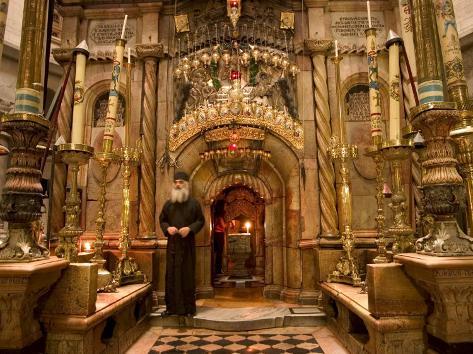
Christian Holy City
Islamic Holy City
-Jerusalem-Temple_Mount-Dome_of_the_Rock_(SE_exposure).jpg/1280px-Israel-2013(2)-Jerusalem-Temple_Mount-Dome_of_the_Rock_(SE_exposure).jpg)
As opposed to delving into the pre-Jerusalem portion of Islamic history, I am going to focus my response on Muslims once they entered Jerusalem. Having already taken several Islamic focused courses in college, I was really eager to see what Armstrong had written about Muslims in Jerusalem. I was glad to see her focus on the fact that it was not until the eighth century that there was any pressure to convert to Islam (despite the fact that Islam is still not supposed to be a universalizing religion). As the Islamic empire spread, there was only one Islamic holy site in all of Jerusalem, and Christians and Jews were treated with respect by their new governor. However, with Muslims being a majority, the Jews and Christians were not happy. The Jews were particularly unhappy about the fact that the Dome of the Rock, pictured above, was built where Isaac was almost sacrificed, but the descendants of Ishmael were in control. This place was considered a place where earth and heaven met and was incredibly holy. Jerusalem was becoming increasingly more focused on Islam, but the empire began to collapse. The Umayyad dynasty fell and the Abbasids rose to power, moving their capital to Baghdad. But Jerusalem would remain a holy city in the eyes of Muslims, especially when so many remained in Palestine. Their holy site at the Dome of the Rock is key, plus the three holiest cities to Muslims are Mecca, Medina, and Jerusalem. This is another claim to the city. Plus, with many Arabs moving into the area and settling in Palestine and staying for so long, they also have a claim to part of the region. This further complicates the issue, as it is impossible to push out Jews and/or Muslims.
Both Jews and Muslims have legitimate claims to the territory based on religion. Beyond that, their political claims are legitimate as well. They all lived in the area for years. They built up homes and raised their families in Jerusalem. How does one decide who must leave? Should anyone leave? Should they coexist? Can they coexist? Can they let animosity go? Is this too idealistic of an idea? Is it a realistic goal at all? These are all questions that must be discussed, but only time will tell us the answers.
Discussion Questions:
1. For those who are religious, do you find that your faith impacts how you feel about the issue of Jerusalem in who should live there and control it politically?
2. If Jews began to find ways to worship without having the Temple after the destruction in 70 a.d., does it seem to be religiously imperative for them that they have total control over Jerusalem?
3. Do you think religion should play a role in considering who should control Jerusalem? Or is it feasible that Jerusalem remain divided?

I think it's inevitable that religion will play a role in deciding who ultimately controls Jerusalem. The religious and spiritual ties that Muslims, Jews, and Christians have developed to Jerusalem are just too strong and historical. I don't think this is necessarily a bad thing, however. Joint administration by representatives of all three faiths could happen over a united Jerusalem, for example. I don't think it's ideal that Jerusalem be split up among members of different faiths (I think all people would like to see a united Jerusalem), but I also don't see any of the faiths relinquishing their claims to the city to an international body like the United Nations.
ReplyDeleteAre you suggesting maybe a separate government entirely for just Jerusalem? I agree that no one would let an international organization rule the city, but maybe a representative of Israel and Palestine could control it? Or representatives of all three faiths? Although I don't see Christians as wanting to control Jerusalem as much as wanting to retain the ability to visit the city.
Delete