Wednesday, March 26, 2014

Week 11 Discussion Response


(One of the World Record-winning plates of Hummus in Jerusalem that we talked about in class... I want to eat it)


When watching the videos and reading the articles this week knowing that we were going to discuss cultural appropriation, I immediately kept my eyes peeled for signs of it. At first glance, I didn't quite understand how we were tying food to cultural appropriation; food is food. Even after finishing the assignment, I was still somewhat confused, as I thought it only made sense for Israelis, living in the Middle East, to eat Middle Eastern food, especially since many Israelis are originally from Arab countries. So in my reading response, I quickly brushed over the topic and didn't delve into it very deeply because I didn't think it was necessary. After our conversations in class this week, I see that I was wrong, but not 100%.

It isn't appropriate to call something cultural appropriation when (a) it isn't negative AND (b) it isn't being taken from somewhere else (emphasis on the and because one of these conditions isn't sufficient on its own). Since many Israelis are from Arab countries and have lived there for generations, and some being Arab themselves, they are not taking anything away from Arab cuisine. They are not claiming that it is their own and ignoring where it came from. It is only logical that they would continue to eat the food that they have eaten for generations, even when they move to a new political state and change their nationality. It also makes sense that when someone moves to Israel that they would eat the cuisine offered to them by those who run restaurants, many of whom are making this Middle Eastern food that has been eaten in that region for centuries. They are simply assimilating into the culture that they see, and Middle Eastern food has become very much a part of Israeli culture. Thus, I would not call this facet of our conversation cultural appropriation.

Here is where I see cultural appropriation entering the conversation: when Israelis eat this food and claim that it is Israeli and only Israeli, uninfluenced by Arabs. This is (a) very negative in nature and (b) being taken away from Arabs and coveted by Israelis, even though these people who are Israeli have been been raised on this food for generations. This type of distinction seems unnecessary, as who wants to create a problem out of food? However, as we're seeing in class, this is a problem.

The problem that I see is not people enjoying the same food and just wanting it to be theirs, but people having a political conflict and taking every facet of life and creating a problem from it to create a further separation as opposed to using the similarity to bridge the divide. Does this make the problem cultural appropriation, or an entirely different type of problem? I'm not sure how to answer that, but it could be a mix between the two. I think the most important aspect of the conversation, however, is that people who share something wonderful (and delicious) in common are using that wonderful thing to further divide each other. While Israelis are to blame for the cultural appropriation side of the problem, both sides share the blame in perpetuating an unnecessary fight over food.

Sunday, March 23, 2014

Week 11 Reading Response


Whoa, week 11 already! This was a much less intellectually-taxing week, but I did the readings before dinner, which I don't recommend because it was basically torture.

To start, the first thing I thought of for some reason was this short film, "The West Bank Story," about two competing restaurants right beside each other in the West Bank, one run by a Jewish family and the other by a Palestinian family. I saw it a long time ago and it's actually pretty entertaining. So here it is!


One point that struck me about Lebovitz's piece was when he said, "I'm not a very spiritual person, but you just need to walk the streets of Jerusalem, or step into a place a worship, and see how powerful the city is." I find it interesting that no matter the background of the people whose pieces we've read or the people we've spoken with on video conferences, they all say that Jerusalem is an incredibly emotive, powerful place. While this isn't really tied to food specifically, it's just something that makes me want to visit Jerusalem even more to experience.

I thought the freshness of all of the food in the pictures and videos made it all the more enticing. In the US in general, we do not really experience food like that wherever we go. We mostly go to grocery stores and have produce imported from all over the world. I can imagine that in a place with so many cultures, no matter what food they prefer, it is easy to get the ingredients to make whatever they want. It reminded me of when I was in Italy and there were produce stands everywhere with produce grown at home, or other baked goods made at home. It all just looks so wonderful that I cannot imagine anyone having any kind of disagreement about food.

I thought that discussion of cultural appropriation within the context of food during the videos was a little strange. Appropriation has a very negative connotation, but since many people in Israel are of Arab descent, it would only make sense that the food they cook would be influenced by their own culture. Not to mention that Israel is a melting pot/tossed salad/whatever you want to call it. To me, that would be like saying that Americans are culturally appropriating when serving German-style frankfurters. I don't know if maybe I was missing something, but I was wondering what you all thought about that.

Discussion Questions:
1. For those of you who have been to Jerusalem/Israel, besides the influence of Arab and other Middle Eastern food discussed in the videos we watched, what other cultural influences on food have you seen?
2. Do you think that food can be a unifying enough experience to be used to bridge understanding between Israelis and Palestinians within Jerusalem, perhaps through some kind of unification project?

Thursday, March 20, 2014

Week 10 Discussion Response

This is a picture from the Miss Israel pageant and Jewish women of different backgrounds are represented here, so I thought it was a fitting picture.

Since it's been a while since we've had a discussion, I really enjoyed talking with you all today! The readings that we've done since our last discussion have been some of my personal favorites, so hearing other people's perspectives on things was fabulous and refreshing.

I was glad we had the opportunity to discuss different identities. I didn't know until today that there was more tension between Mizrahi women and Palestinian women than with Ashkenazi women. This was kind of sad to me, as both Mizrahi and Palestinian women experience a very different, more difficult struggle than Ashkenazi women. It's always disheartening to see any group (in this case women of the region) divide on classist lines, as it's merely an issue of status as opposed to a deeply rooted, fundamental difference in ideas. I find the lack of understanding and unity to be the product of society, as most social issues are. This leads me into a discussion of our conversation with Galit Hassan-Rokem.

Speaking with Galit Hassan-Rokem, she mentioned something very interesting: her name sounded Mizrahi, so she was often mistaken as being Mizrahi, despite being Ashkenazi. This makes sense, as her last name sounds very Arab (when was the last time you heard someone with the last name of Hassan and not immediately associated them with Arabic?). But that assumption of someone's identity can change the way you view them. Mistaking someone's identity isn't necessarily a problem. It happens all the time, the issue is usually rectified after a conversation, and people move on. But considering the experience of Mizrahi women, and the interactions between Mizrahi and Ashkenazi women / Mizrahi women and Palestinian women, this misunderstanding could present a problem. As we found out this week, the tension can often be visible in every day experiences in Jerusalem. I would be interested to know if Galit experiences different treatment regularly when people become aware of her name.

"All of Israel is part of the occupation. I am also part of the occupation." When Galit first said this, I was taken aback for a moment. In political situations, I don't like to think that people are simply born as a part of something, especially not part of such a big problem, without choosing it (whether under pressure or not). Of course people are born into all sorts of issues, but whether or not they consider themselves part of the issue is an entirely different matter. I reflected on this more later and it definitely makes more sense. Living in Israel would require one to be part of the problem. They participate in government-funded programs and activities, which perpetuate the occupation. However, I'm still not sure I agree with her statement (and I want to hear what other people think about this). People don't really have an option when they are born and raised in a particular area. So long as they are not making the problem worse, and even taking steps to alleviate an issue, they are not part of the problem. Galit herself is an activist who speaks out against the occupation. While she participates in government-funded activities and programs, she is also a citizen of a country and should be able to enjoy life comfortably without feeling like she's a part of something that she protests strictly by virtue of living where she lives. Maybe she meant something more by what she said that I'm not touching on here, but again, I'd love to hear what everyone thinks because that specific comment was definitely the most striking part of the video conference for me.

Monday, March 17, 2014

Week 10 Reading Response: Feminism in Israel


This week's reading assignments definitely highlighted a majority point with feminism everywhere: it's complicated. It's never easy to talk about feminist issue without recognizing a variety of nuances that play into the way women experience society: sex versus gender, ethnicity, socio-economic status, etc. There was a clear distinction between the way Ashkenazi and Mizrahi women experience living in Israel, but they shared common feminist goals as well.

A key point was class transcending feminism. Further along that vein, the division is ethnic, which is directly related to class in that Ashkenazi women tend to be much wealthier than Mizrahi women. This issue has been seen throughout many social justice movements within history, including the feminism movement in the US in which white women were still racist against black women, the latter of which deals with an entirely set of problems that the former does not experience. There was also a distinction drawn between Haredi women and other Jewish women in general. I was glad that we read a variety of readings that noted that the many different experiences that women deal with depending upon their ethnic or religious group, and I'm sure we've only hit the tip of the iceberg.

The plight of Palestinian women in Israel was an issue in itself. Saar explains that Palestinian women must deal with multiple patriarchal regimes: the family, the state, national community, and others. Palestinian-Israeli as an identity in itself is oxymoronic, as the author notes. She also notes that while Palestinians in Israel are better off than their brethren under the Palestinian Authority, their quality of life is much lower--for both men and women. The identity is so complex and the state treats Palestinian-Israelis so much differently than Jewish-Israelis, as is highlighted by Samira, even if individuals do not discriminate. The complexity of this issue is fascinating to me and I'd love to talk about it more in class (as I'm sure we will).

On a related note that slightly strays from feminism, at the end of Galit Hasan-Rokem's article, she said that she hoped for an undivided city, which is to be the capital of two states of two nations. I have never really heard anyone discuss the idea of Jerusalem being the capital of both states in an undivided way. I just think that this idea is interesting and hope we get the chance to talk about it more in class.

Discussion Questions:
1. Do you think it's possible for Galit Hasan-Rokem's idea about Jerusalem being an undivided city, but the capital for both states?
2. In reading about Palestinian women's experiences in Israel, did you see their struggle as more politically motivated, gender-related, or a bit of both? In other words, do you think that if these women weren't Palestinian in a political sense, would they have the same struggles as Jewish women in Israel?

Thursday, March 6, 2014

Music!

Sorry for the last post, everyone! I got stuck at work until late tonight... bleh. But here I am, ready to talk about one of my passions in life--music!

Music has played a massive role in my life, as I'm sure it has for many of you. I grew up playing piano (and still love it to this day!), and eventually began learning drums and guitar. I also took voice lessons for a period of time and have enjoyed studying the creation of music as an intellectual pursuit. I love the universality of music. Even if you don't like the same music as someone else, everyone, in general, can all say that music is something that they enjoy.

I associate music very much with memory. The sound of a certain song or album will bring back memories from specific moments, people, seasons, and life situations. The way music is so ingrained into the brain is phenomenal and never ceases to amaze me. It provokes such strong emotion that's inexplicable until you experience the emotion itself. I get a similar feeling with other sensory experiences as well, especially smell. But music is a very special experience for me. It has been something that has allowed me to escape from what's going on around me, enhance great experiences, and quell moments of overwhelming anxiety. It is with me when I'm sick or sad. It has also started many conversations that have blossomed into beautiful friendships. It also transcends language barriers depending on what it is. I have been able to connect with non-English speakers through music, which is an incredible experience.

I have many musical favorites that provoke different emotions for me, or I prefer to listen to during different activities or seasons. I am a huge r&b fan, but also really enjoy screamy/shouty post-hardcore. I've posted some of my favorites below (and noted if they have language that may offend some). I hope you enjoy listening to them and I'm excited to look at other people's posts, as I really love talking about music. I like to know why people like what they like, as music opens an entirely new door for conversation.

Let's let the music do the talking!

Bjork: Undo
If I'm ever feeling anxious or need to study, she's my go-to girl (along with St. Vincent/Annie Clark... you should find her if you don't love her already)


The Weeknd: Heaven or Las Vegas (Warning: language!)
The Weeknd is one of my all-time favorite artists. I listen to him every single day and often fall asleep to Abel's sweet, sweet voice. You may know him via Drake promoting him, but listen to him without Drake and you'll probably want to kiss his face.


Sunny Day Real Estate: In Circles
Sunny Day encompasses many of the things that I love musically. It's gritty, loud, shouty, and intricate.

Death Cab for Cutie: Two Cars
But really, who doesn't love Death Cab?


Kendrick Lamar: M.A.A.D. City (Warning: language!)
This entire album is about Kendrick growing up in Compton. He explains that he was born to be a very peaceful soul, but the life he lived there forced him into gang violence and he hates that that's what he became, as it isn't who he is. It's seriously one of the most thought-provoking albums, even if it doesn't seem to be on the surface. He's one of the most moving rap artists, along with Immortal Technique (but I won't rehash that obsession).


The Goo Goo Dolls: Iris
This has been my favorite song since I was in Kindergarten. It's one of the most comforting songs for me to hear since I've loved it my entire life.


Young Magic: Sparkly
If this doesn't calm you, I don't know what will.


Sun Kil Moon: Moorestown
This entire album, "April," was written about the artist's (Mark Kozelek) long-term girlfriend who died in April. It's probably the most excruciatingly painful albums I've ever heard, but also hauntingly beautiful. Every single song is just perfect. If you want to have a good cry fest by yourself, take this with you. Or just listen to it anyway and try not to cry.


Saosin: Lost Symphonies
Because anything that Anthony Green has ever touched brings me back to really great times in my life.

Owen: Playing Possum for a Peak
If you enjoy acoustic at all, you will freak out at how great this song is.


Interpol: Obstacle 1
It's just phenomenal. All of it. I'm sure someone else in here MUST be an Interpol fan.

Saturday, March 1, 2014

Week 8 Reading Response


This week's readings all warrant separate responses, so I'm going to go through each one individually to give it the attention it deserves.

"You're So Pretty--You Don't Look Moroccan"
Henriette's experience as a Moroccan Jew in Israel was surprising in one way and not at all surprising in another. After collectively experiencing the tragedies of the Holocaust and attempting to create a solidified Jewish state, the Jews of Israel were still not united for a common goal. After experiencing such intense discrimination in Europe, they still discriminated against each other. This is not to ignore the pluralism found in Israel that we've been studying. It makes sense that there would be tension among a population of Europeans, Moroccans, Arabs, and others, as there are huge social, cultural, and class gaps. However, it's still surprising that there was not more unity and such dehumanization of Moroccan Jews by other Jews. It was incredibly disheartening to read the essay. Hearing about someone suppress who they are in order to appease others is inexplicably depressing. But I also found that I wasn't too surprised about this type of behavior in light of how many Arabs describe their experiences in Jerusalem today.

"A Dog's Life"
Everyone loves a story with a dog in it. But this story unveiled a sad truth. Suad's use of her dog's passport to get into Jerusalem was strange for several reasons: (1) why does a a dog have a passport... and (2) why can a dog cross a border (WITH A PASSPORT), but a human cannot? Humans should be able to fairly easily pass through one border to another. While obviously the situation between Israel and Palestine is different than, for example, the US and Canada, Palestinians should still be able to cross a border with more simplicity than Suad experienced. Border crossings are definitely different stories than checkpoints or outposts in occupied territories. The beginning of the Ramallah Diaries was very uncomfortable to think about, as people were being forced to stand in straight lines and board buses when told. It reminded me of the countless stories I've read over the years of people being lined up and put onto trains to concentration camps, and the irony of the story was incredibly striking. Again, this is clearly a very different situation, but the similarities makes one think a lot about the hypocrisy in the actions of the IDF, at least in these types of situations.

"Palestinian Christians in Jerusalem"
When we talk about the issue of Jerusalem in terms of religion, in general we are talking about Jews and Muslims. Thinking about the Palestinian Christians as a minority group also made me think more about how Christians as a whole feel about Jerusalem and the sense of belonging that they feel to the city. As a Catholic, I recognize that the hierarchy of my religion as control over its own territory and, arguably, much of the state of Italy. While Catholics also feel an attachment to Jerusalem as a holy city, they don't feel kicked out of any area, or that they cannot travel to other places due to their religion. But the issue within the essay was a mixture of religion and ethnicity, of Christianity and the Palestinian identity, as it connects to Jerusalem. Many Christians travel to Jerusalem from all over the world during Holy Week and Christmas without an issue, but Palestinians that live right next to the holy city have difficulty traveling to their holy sites. This is heartbreaking for many people, and for me to even hear about. Not only are they denied a religious experience, but their identities are being denied not just as Christians, but as Palestinians. No other word but "sad" really sums up my reaction to the essay, despite it not really being new news. But the reminder is always a disappointment.

"Parallels and Paradoxes"
I'll just start by saying that I love Edward Said and that he is one of my favorite authors/intellectuals; so this reading was great for me and I would talk about it all day. But I'm going to focus on one specific point of the reading that made me think more about the idea of courage. When they are talking about the "art of compromise," Barenboim describes the method of a cowardly statesperson versus a courageous one within the analogy of a musical composition. He says that a coward will write in a more physically simple way; in other words, at the end of a crescendo, notes will remain louder and then eventually make a decrescendo into softer notes. A courageous person will write in a more difficult way, making a crescendo and then shifting into piano notes as opposed to forte notes. As a pianist, I can tell you that this is an art that's difficult to master and actually do well. It's definitely a more courageous way to write if your goal is to create something that's appeasing to the ear. However, I had a hard time agreeing with that in the context of diplomacy. Is it courageous to be unyielding, or is it more courageous to pick battles to satisfy all involved? Or maybe he was referring to it being courageous to not allow anyone to stop you from reaching a solution agreeable to everyone? I interpreted it to be the former, but it was strange to me that Said wouldn't argue with this idea more if that were the case. I'd like to know everyone else's thoughts on that, as it was quite thought-provoking.

Discussion Questions:
1. Did you find any parallels between the behavior towards Jews in Europe and the behavior towards Arabs in Palestine/Israel?
2. What did you think about the courage-coward idea that Barenboim discussed? What do you think he meant, and how would you define courageous and/or cowardly behavior on the part of statespeople?

Thursday, February 27, 2014

Week 8 Discussion Response

This week was an awesome learning experience for me. I didn't know much about Orthodox Jews, so our discussions and readings really caught my interest and caused me to do more research on my own. I wish we could have gotten more "inside" information about Jerusalem Open House, but our speakers this week were still engaging and interesting. I also really want to partake in Shabbat of a Lifetime now... I'm hungry just thinking about it.

I would like to know more about the LGBTQ community in Palestine. From our speaker today, it sounded like it isn't a very public community due to cultural oppression. I would be interested to know if there are organizations in other parts of Palestine that promote LGBTQ rights. The speaker today suggested that that is unlikely, but I'm sure there's one somewhere. After reflecting on today's conversation, I feel like I'm left with a lot of questions, which should make for a fun weekend on the Internet.

I am acquainted with mandatory IDF service, but am unfamiliar with the alternatives that we talked about today. I really like the idea of mandatory service to one's country, as it requires direct engagement with community and allows one to become aware of something other than their own lives, which is really lacking the US (from my observations and experiences). I attended a school that required community service every year, so we were forced to actually go out and do something for someone else. While many Americans volunteer at different places, there are a painful number of people who never do and only focus on themselves. Just scrolling through my newsfeed on Facebook reminds me how absorbed we all are in our own lives. So I am interested in learning more about people's experiences doing mandatory service in Israel.

Sunday, February 23, 2014

Reading Response Week 8


The LGBTQ community experiences discrimination everywhere in the world, so reading about their difficulties in Palestine and Israel was unfortunately not a surprise to me. I watched the clip for the City of Borders documentary and was struck by the line that the Israeli Adam said: "When you hide [your identity], something is wrong." Considering the religious influences of the region, this seems like something one would have to do. It's sad that in a modern democracy that the discrimination was as fierce as the people in the documentary explained it to be just within those brief clips. It's not only sad that people are suffering in some part of the world for doing nothing wrong, but disheartening for the LGBTQ movement worldwide.

In our assignments for this week, I got the feeling that Haredim Jews are looked at the way that Amish and Conservative Mennonites are viewed in the United States, but with a politicized twist. In other words, their practices are respected and anti-secularism seems strange to outsiders. But unlike Amish and Mennonite communities, they strive to push and expand their beliefs onto others within their own religious groups (so Haredim Jews onto secular Jews). I am not sure if this is a correct analogy, so someone correct me if I'm viewing this the wrong way, as I don't know much about Haredim Jews in a social context. I did not know about their unemployment problem and poverty rate. They are aware of their problem and realize that their choice to adhere to their customs comes with a cost, so I am unsure of how Israel will try to solve the poverty issue, or if they will be able to push this sect to do things that they may not want to do in order to help Israeli society grow and not place a financial burden on the Israeli government.

I had heard about the Ultra-Orthodox wedding before looking at these pictures, but did not realize what a huge deal it was before looking at the article assigned for today. The aesthetics of the wedding were beautiful and seeing the traditional aspect of the wedding was fascinating to me. I then Googled the name of the bride, and the first suggestion that Google had for me was "Hannah Batya Penet face," followed by "Hannah Batya Penet unveiled." It was interesting that everyone looking her up online wanted to see what she looked like, which seemed to defeat the purpose of her being veiled for the ritual. Just as a side note, I think it's interesting how much we want to put a face with a name. Equally as noteworthy is that I could not find a picture of her face anywhere online.

Discussion Questions:
1. Israel and Palestine are places with very strong religious influences. Do you think that the LGBTQ community will ever achieve equality as they would in a more secular place?
2. Did you get the idea that Haredim Jews were viewed more negatively than other Jews? If yes, did it seem to be for the way that they interact with other Jews, or perhaps because of their economic place in Israeli society?

Thursday, February 20, 2014

Final Project Outline: Christian Zionism


My final project is going to focus on the research of fundamentalist Christianity and its interpretation of biblical text that has propelled the movement toward Christian Zionism. Christian Zionism pushes for the settlement of Jews in Israel, specifically in Jerusalem.

Goals of my research:
(1) Examine how dispensationalism created the Christian Zionist movement.
(2) Examine biblical texts to gain a deeper understanding of the movement (specifically the Old Testament and "end-times" philosophy)
(3) Examine the philosophies of different thinkers in this field.
(4) Explain different Christian interpretations on this Zionist movement in light of biblical texts.
(5) Offer potential solutions, if any, to create a more tolerant and cohabitational view of Jerusalem in the Christian narrative.

Format: I am still unsure of the media I want to use to create my project. As it starts to come together more, I will decide if I would prefer to do a blog-type format to put the information online, or I may create a powerpoint presentation. The focus is going to be research, so as I compile information, I will better know how to relay this information in an interesting and engaging way.

Current sources of information:
(1) The Bible (obviously), specifically a Protestant version that includes apocryphal literature.
(2) Pat Robertson, who is currently a strong figurehead within the Christian Zionist movement: http://www.patrobertson.com/Speeches/IsraelLauder.asp
(3) Christians United for Israel: http://www.cufi.org/site/PageServer
(4) Karen Armstrong's One City: Three Faiths

Wednesday, February 19, 2014

Separation Barrier


I try to push my preconceived thoughts out of the way when writing these posts and reading information that may be new to me. I want to have a fresh perspective on something as key to Jerusalem as the separation barrier, but I have found that I have a stronger opinion than I had had before doing the research. I was hoping I could see both sides of the argument, but I see very little of one side as opposed to the other. I wanted to preface my response with this so as to be honest about my personal bias, which has been formulated by the assignment we were all given. I look forward to our conversation tomorrow to see if everyone else felt this strongly about this particular issue.

Israel began to build the separation barrier in 2002. The plan is for it to be 709 kilometers long, which is twice the length of the Green Line. It contains a physical wall, but also fences and barbed wire. It will not only annex almost 10% of the West Bank, but it also isolates parts of Palestinian territories so that Palestinians don't have access to other towns in the West Bank. (2) Furthermore, Israel has had a total of six different separation walls throughout the country between it and other Arab lands. It has taken down two of the six that have existed.

The barrier has halted parts of Palestinian life. Teacher cannot get to the schools where they teach, families are physically separated from each other, towns are completely blocked from each other, leaving some unable to get to hospitals, Palestinians cannot get to work, farmers are separated from their crops and animals. Palestinians who have submitted petitions to Israeli courts to cross through the barrier to get to their property have had their petitions denied. The established checkpoints do not allow Palestinians to freely move from one place to another, and even those who have permits to do so are not guaranteed to get to where they need to go.

Israel has annexed nearly 10% of the West Bank into what many consider Israel's future border. There is simply absolutely no consideration for the rights of Palestinians in this case. The barrier has allowed Israel to put all of their West Bank settlements within the confines of the wall. I cannot conceive one day waking up and having my family's property cut in half or on another side of a wall from me. I cannot imagine having that wall declared illegal by the international community and by international law, yet that meaning nothing to those that constructed it. The wall is speaking to the future generation. It is saying that it is okay to violate the sovereignty of a neighboring territory. It is saying that it is okay to unilaterally and arbitrarily determine your own borders without consulting neighbors, whose borders are obviously going to be impacted by the drawing of your own borders. It is saying that it is okay to build up a wall and not confront a conflict head on. It is saying that it is okay to not legitimize the other group with whom you are supposedly negotiating with.

Israel has the right to protect itself from physical harm. It has the duty to protect its citizens from harm. No one would argue otherwise, but their construction of this border is harming Palestinians every day. It was also declared illegal under international law. The overwhelming majority of the ICJ has called for the dismantling of the barrier, as well as for the international community to not recognize the wall as legitimate. If you want to read the advisory opinion of the ICJ (if you didn't see it when you were researching), here it is. (1)

I do not mean to be divisive with this post. I appreciate the dialogue that we have in this class and how respectful everyone is of everyone else's opinions. However, I cannot help but feel angry when reading about this barrier and how it impacts people every single day. We have seen barriers in the past that have been nothing but unhelpful. How is this one supposed to be any different?

Discussion Questions:
1. Do you think that some type of separation barrier is necessarily a bad thing for the peace process, or could it be beneficial for both states if constructed on an agreed-upon border?
2. Do you think that Israel really has an obligation to take down the barrier as suggested by the ICJ?

Citations:
(1) http://www.icj-cij.org/docket/index.php?pr=71&code=mwp&p1=3&p2=4&p3=6
(2) http://www.btselem.org/separation_barrier/map

Sunday, February 16, 2014

Week 7 Reading Response on Music

As someone who loves and is pretty knowledgeable about hip-hop, reading about the development of hip-hop in Israel was strange, especially coming from an American perspective. Hip-hop was formulated in the 70s here, so to think of it developing in a much more modern context (1990s), and within a country of physical turmoil, changes how hip-hop should be viewed. But the commonalities between American and Israeli hip-hop form their bases: groups of people being ignored by their governments and societies using music to express their dissatisfaction with this. Hip-hop was the logical child (in some respects) to disco, funk, and mow-town, but it really developed into something beyond dance and having fun and was used to project a reality experienced by an oppressed segment of society. But Israeli rap didn't build upon anything--it was its own thing. Knowing that rap is incredibly prominent here, I can't imagine it not being incredibly successful in a modern place like Israel, so I will be interested in keeping tabs on how it develops at least out of curiosity.

Learning about the foundations of hip-hop in Palestine seemed more similar to the American hip-hop narrative: those being oppressed used hip-hop as a way to express their turmoil and dissatisfaction. I had never heard of DAM so reading about them was great and I look forward to looking up more about them. I especially appreciated that they created a song about violence against women. It reminded me of the Immortal Technique song "Dance with the Devil," which is about a violent gang rape and murder of a woman, the former perpetrated in part by her own son. The connection was extremely sad and the themes are chilling, but the goal of many musicians is to incite some sort of emotion in the listener. Rappers often paint realities that many listeners would otherwise have no idea about or give them something new to learn. I was pleased to see that DAM was putting forth a message that needs to get out. The foundations of rap are really to send a message.

Music is such a great way to link people together. No one ever meets a person who says, "I don't like music." Everyone loves music, no matter they're from, what they do, or how old they are. Even people who dislike each other personally can usually unite over mutual musical enjoyment. The Heartbeat Project has taken hold of that fact, which is great! Many people play instruments (or want to), love to sing, or just appreciate a nice melody. Most people want to create music when given the chance. It's just infectious and such a positive thing. It flexes parts of the brain not always used. It can require discipline and be a serious skill, or it can just be mindless. Regardless, it's always enjoyable and transcends so many boundaries. While lyrics can be used to highly politicize music and make it divisive, it isn't typically a divisive thing. I was somewhat surprised to see that the Heartbeat Project was created on a Fulbright grant, which I thought was a really cool and experimental idea. In high school, one of my teachers coordinated a drum circle in which handicapped students and regular-ed students would come together to play drums. Students that would normally not have a chance (or perceived reason) to interact could come together for something fun. Seeing a social gap be bridged by music is powerful. I don't know anything about the Heartbeat Project beyond what we read, but I hope it's just as successful in a part of the world where there is a lack of understanding between two groups of people who live amongst each other.

As a side note... 
The first link we read, which was to the PDF on the guide to Channels of Rage, I noticed that when describing the Second Intifada, the author said that 1,000 Israelis died, but did not mention that nearly 3,000 Palestinians died during it. I thought that was a rather strange thing to exclude, but interesting to note in light of our discussion this past week on including (or not including) certain facts and how that influences the perception of the article and shows bias. I didn't know if anyone else noticed this or was frustrated with the lack of that fact, but I thought I'd share.

So, to leave you with something that really shows the power of music, specifically hip-hop, I decided to share a song that I found to be incredibly powerful and mentions Israel and Palestine throughout the song, so it's relevant for our purposes. Just a forewarning, there is strong language in this song! But it's quite moving. Immortal Technique is one of the most intelligent and eloquent individuals in the music industry right now, so I hope you enjoy and agree!


Thursday, February 13, 2014

On bias...

Someone posted this article on Facebook and I decided to share it here. Since we had talked about bias, I thought the perspective that the author asserts that he has to be interesting. He claims to not really have had much background on Israeli-Palestinian issues before going to visit the region. Some of the language seems unnecessary to me (like calling a person's look "deranged"). Aside from that, I think it's definitely worth a read.

http://www.huffingtonpost.com/ferrari-sheppard/i-traveled-to-palestine_b_4761896.html

Journal 3

So to talk more about the physical things in my life that represent who I am and my background, I have included several pictures. I'll talk briefly about each one since, as they say, a picture is worth a thousand words!

My family

So here's a somewhat awkward family photo from Christmas. It's of me, my mom, my sister Maria, my grandma, my brother-in-law Nathan, and my brother Christian. Of course, the dogs made in into the photos since we're pretty obsessed with them. I am extremely close to my family. Since a lot of people say that, for emphasis, I should add that we're pretty abnormally close, bordering on claustrophobic, but I'm very much okay with that. Italian families (unlike Italian politics) are matriarchal in nature, so my grandma has been the head of our household. She and my mom have been the main decision-makers, so I have grown up around very strong women that I admire. I was raised by my mom and my grandma and we are all loud and overbearing when we're together. I also consider my relationship with my mother to not just be a mother-daughter relationship, but a friendship. This has really impacted my outlook on the way I view family. I don't view a traditional hierarchal family; rather, I see one based on friendship and understanding, and this allows me to really open up to my family more than most people would probably feel comfortable with.


My pets


The first picture is Sophie, my puppy (actually dog, but whatever). We've had her since I was in the 5th grade and she's been wonderful. Whenever I am sick, she sits with me. When I'm home, she follows me everywhere (as in I can't even go to the bathroom alone... score). But it's endearing. The picture below is of Lily, and the two below that are of Eleanor. They look identical, but they're actually from different litters. Long story short, we got them at the same time and they've grown up like sisters. We think Lily communicates with spirits (haha... no but really), as she likes to stare into space and move her head in circles. It's bizarre. Eleanor is obsessed with sinks and sits in my mom's sink all the time. She actually will meow at you until you follow her into the bathroom and pet her while she sits in the sink. They're just goofy little creatures.


Jewelry as symbols

Jewelry has always been a big part of my life, as my family has passed down several pieces of jewelry for generations. I also used to make jewelry when I was in high school and sold it. I wear much of the same jewelry ever day, as they are all different symbols for me culturally and religiously. The picture above is of my "13" or "tredici" pendant. It was my great-grandmother's from Italy. Thirteen is actually a lucky number in Italian culture and seventeen is an unlucky number, which is definitely different from the American view of thirteen. "Tredici" was often said to those who have bad luck to bring them better luck in parts of Italy. While younger generations are starting to associate it with bad luck due to films and other negative representations from the US, older generations still stick to the tradition. It was passed from my grandma to me and I'm always wearing it. I also wear the cornicello, which is basically the Italian version of wearing an evil eye. It's a very common Italian good luck charm that I'm sure many of you have seen. I also wear a Mary and Jesus medal, which is a tiny replica of Our Lady of Perpetual Help. It's very common for Catholics to wear something that honors Mary, especially Italian Catholics. I also often wear several Italian gold rings, which have been passed down to me. I also often wear a gold snake ring, which is an ancient symbol of wisdom. My mom had one and got me one, as I've always loved them and what they represent. Most jewelry that I choose to wear has some sort of symbol attached to them.


Catholic Art
 

My favorite painter is Raphael, who was a painter during the "Rinascimento," or Italian Renaissance. I'm sure many of you have seen his paintings, as they are extremely famous. He was commissioned by the Medici family of Firenze to paint many important political and biblical figures. My favorite painting is "Madonna della Sedia," meaning "Lady of the Chair" (because "Madonna" is old Italian meaning "my lady"). It's literally the Virgin Mary sitting in a chair holding Jesus. I think it's absolutely beautiful for a number of reasons. I have it hanging above my bed. At my mom's house, many depictions of the Virgin Mary and Jesus can be found hanging. Mary is very significant to Catholics for the acceptance of God without question and being conceived without sin for her destiny to be Jesus's mother. This is the religious narrative, but besides that, her place in the bible as a role model is key to understanding the honor placed on her. The second picture is from when I studied in Italy. It's the "incorruptible" Santa Caterina di Bologna. I just thought it was really cool, so I decided to include it, as it also shows the gorgeous, ornate churches of Italy. The picture is kind of blurry because I was physically shaking. It was one of the most interesting and overwhelming experiences of my life, perhaps because of how beautiful the setting is, or because I was in a room alone with a person who has been dead since 1463. Either way, incorruptibility/the picture is pretty sweet.


Wine

My grandfather was a winemaker (among several other things) and wine has always been a big part of my family. He used to drink wine, as when he was little in Italy, the water was not safe, so many people turned to wine. Chianti is my personal favorite. It's very strong, as it is the final pressing of the grapes. The taste is exquisite. I have a lot of useless knowledge regarding wine, so ask me things if you want to know more! The above bottle was one of my grandfather's.


Books


Ah, books. They are the best solace! I was always a bookworm growing up and my collection of books is pretty huge. This is only what I brought with me from home and I have a lot more at my mom's, but I'm running out of room on my bookcase. It's a problem. I need a bigger one, but a studio apartment isn't going to hold another bookshelf. Many of my favorite books are non-fiction history books. I also have a pretty sizable collection of Khalil Gibran books. So you guys should all check him out.


Piano

I have played the piano since I was 6. I have my piano in my tiny apartment and it's taking up a lot of room, but it's worth it. I used to play drums and guitar (the former much better than the latter) and I also used to take voice lessons. Piano stuck with me the most out of all of those musical options. I love it and consider myself a pretty skilled pianist. Music has always been a huge part of my life, as my uncle and brother are amazing drummers (and my mom used to play), my sister is a skilled pianist and singer, and my brother-in-law is a music teacher. I also spend a lot of time listening to new things and really enjoy breaking down songs and focusing on various instrumentation.


Vintage everything

I avoided taking pictures of my entire apartment so as not to be creepy. Every piece of furniture I have is vintage and I have an Etsy shop where I sell vintage clothing. This love was instilled by my grandma, who used to take me to antique stores when I was little. I'm obsessed with antiques and love attempting to appraise things on my own. It's always been a side-love for me next to the political love that has taken over my life.


Roses

To end, my middle name is Rose, so I have been flooded with floral everything since I was little. So I basically have had no choice but to grow to love roses. So vintage rose things pretty much cover my apartment and I frequently wear them and it's become a big part of my aesthetic. Go me.

I talked about myself/culture/family way more than I had planned. But it's easy to talk a lot about something you know very well I suppose. I look forward to reading everyone else's journal responses to get to know you all better!

Monday, February 10, 2014

Reading Response Week 6


Here are the three articles I selected for my reading response this week (and I imagine many of you probably picked the first settlement one as well): 


To draw on Dr. Nassar's article, the author of each article clearly has a goal, similarly to the way photographers have a goal in taking pictures. They want to provoke some type of thought in its readers (or viewers of photography). While multiple meanings can be taken from a text depending on the background of a reader, a bias can often be pulled easily from a news article. While reading these articles, specifically the second one, I thought the comments were interesting and told me something different about the bias of the authors. Focusing on the second article for a moment, if you look at the comments, everyone is obviously talking about their take on the information in the article. Most of the comments were very defensive of Israel, which makes sense since the readers of JPost are probably interested in supporting Israel rather than being in conflict with it. The article seems fairly neutral (and a little in favor of) Kerry and the commenters are outraged that Kerry even wants to butt into Israeli affairs. I found that I had a somewhat different perspective on the article after reading it, as I originally saw the article as neutral. While I still find it to be definitely be fair, I can now see that the JPost Staff views Kerry in a positive way as opposed to the antagonists that the commenters see.

The articles I chose mostly focused on the politics of Jerusalem. The third article mentions people's reactions to the idea of a divided Jerusalem. I thought the term "Jewish extremists" was an interesting choice of words, as it suggested a bias from the author. Other than that, it just discusses a potential deal between Israelis and Palestinians. The comments also suggested something interesting, specifically the one that said that Jerusalem rightfully belongs to Israel and cites the Bible as her evidence. As a side note, I found it sad that someone would solely cite a religious text as opposed to view the conflict in a greater political and social picture.

Media sources have a huge impact on the way we perceive news. They are able to create what we believe to be true or untrue. It's always good to go back to Chomsky's "Manufacturing Consent" to see how the media is able to sway people as a whole on way or another and to create truth as we perceive it. Each of these articles, whether biased or not, have the ability to create reality for us and all readers in how we see Jerusalem and the Israeli-Palestinian conflict. This is somewhat unsettling, but it is the only way to gain current information without actually going to the region and getting the news by experiencing everything firsthand. Everything has a bias, be it a news article, a picture, or a conversation with a friend. There is no way to avoid it. We even have a bias in our experiences, as our past and ideals will impact how we see what we are experiencing. With such a controversial topic like Israel and Palestine, it is impossible to get unbiased information, but we can look at both sides. I feel like this class is great for that. We all come from different backgrounds and are able to talk to different speakers and read different sources in order to see all sides, and it is really widening my perspective and allowing me to learn more than ever before.

Discussion Questions
1. How did you find your articles to be in terms of bias? Did you think they were fairly neutral, or were they extremely biased, varying by source? 
2. How do you think biased news sources feed into the conflict? Or do you think news sources (within reason) allow people to see other sides, creating an atmosphere of understanding?

Thursday, February 6, 2014

Final Project Ideas

I had come up with several ideas for my final project and am not sure which direction I'm going to go with yet. But here are the ones that are most interesting to me:

1. Do a multimedia presentation (like powerpoint) on the poverty in and around Jerusalem. I would like to incorporate videos and reports on the issue. I would also incorporate what the US and allies of Israel are doing about it, if anything.

2. I also thought about doing a project focused on fundamentalist Christians, found primarily in the US, supporting Jewish settlement of Jerusalem. I would like to focus on the reasons why, which will draw upon the history of Jerusalem, as well as how that manifests itself today (i.e. monetary donations, lobbying, etc.).

Week 5 Discussion Response


Unfortunately I was quite sick this week and only made it to half a class (yay, the flu!). But even the half of class that I made it to today was fascinating. I had never heard of Ir-Amim before this class, so when I realized what it was all about, I was excited for today's speaker. Hearing her talk about not just the settlement construction, but also the highway construction and the way it physically divides Palestinians from other Palestinians and at the rate at which Israelis are working to push these projects forward was alarming.

As I listened to her speak, I tried to put myself in the shoes of the Israelis to figure out the motivation to push these projects forward so rapidly. Of course they want to push Palestinians out of Jerusalem, but why not negotiate first? Why not use the desire to push these projects forward to propel motivation for peace talks? Why not compromise, like Palestinians pushed for with moving the highway construction? I have not come up with any answers that put Israelis in a positive light. Israelis pushing Palestinians into small, unsafe neighborhoods is a blatant slap in the face to them as human beings. It shows that they clearly have no intention of sharing Jerusalem and no intention of working for the welfare of both groups of people of the region. While the Israeli government's duty is to its own people, it also has the duty to be respectful of its neighbors. Israel does not recognize Palestinian sovereignty and does not have an intention of doing so based on its actions. It's incredibly sad to see this horrid mistreatment of another group of people, perpetrated by a government that receives unconditional support from the United States (and, by extension, its taxpayers). This in no way excuses violence that Palestinians use against Israelis, but it most certainly explains their motivation for using it.

This makes the discussion of peace more complicated. How can one ask two groups of people to negotiate when there is no respect between the two groups? And no desire to work together to end the conflict? It's incredibly difficult to bring Israelis and Palestinians to the table with this type of behavior. It seems almost childish to me that one government is bullying another group of people for their own gains. However, this is nothing new. Israelis have continuously mistreated Palestinians, just as other states around the world mistreat their neighbors. Again, I am not saying Palestinians share no blame, because they do. But they did not bring Israeli settlements, highways, and parks upon themselves.

Discussion Questions
1. What should the U.S. do, if anything, about Israel's construction of settlements, highways, and parks on Palestinian territory?
2. Palestinians have continuously stated that they will not engage in peace talks until settlement construction is halted. Do you think Israelis actually have any intention of doing this?

Tuesday, February 4, 2014

Week 5 Reading Response: Arab Jews


As we close Karen Armstrong's book, I'm sure we all have a better idea about the importance of Jerusalem in a modern and historical context. I am continuously blown away by Armstrong's knowledge of the city and the faiths that have impacted its formation. But with all of that knowledge, even Armstrong cannot come up with a solution to the question of Jerusalem. I'm looking forward to the speaker on Thursday for more insight into the question of a united or divided Jerusalem, especially with the historical context that we now have.

Dr. Tamari's piece was incredibly thought-provoking. It is not often that one thinks about an "Arab-Jew." As Tamari says, that seems to be an oxymoron to many, despite Judaism being an ethno-religious group, not an ethnic group. The most interesting part of Tamari's piece that struck me was the following quote:
"Sociologist Yehouda Shenhav argues that the return to Zion meant little to them, either culturally or ideologically, since they were already in Zion. And for those Jews who lived in Iraq and Syria, the move to Palestine (before 1948) was seen not as a move to Zion, but as a move from one area of the Arab world to another, and thus was not considered to have any ramifications in terms of sacred geography."
Today, this idea is somewhat inconceivable. Seeing a move from Syria to modern political Israel is such a radical difference. Clearly this was not the case prior to 1948, especially for Arab Jews. As far as they were concerned, they were moving from one place to another that didn't vary greatly. They were already in the Levant, and a move did not mean much to them. They already viewed themselves as in Zion. Today "Zion" seems to have such a specific connotation. If it isn't inside of Jerusalem, it isn't viewed as the Holy Land. Sacred geography today comes into play very strongly. It was interesting to me that this viewpoint was brought forward in the reading, as it was something I had never considered or had known to be reality. It makes one wonder how, in such a relatively short period of times, things had changed so radically. Of course the move toward Zionism created a huge rift between Jews and Arabs, but where does that leave the identity group of Arab Jews? While Tamari says that many writers of that time period, like Shami, were not totally comfortable with either their Jewish nor their Arab identities, where does that leave Arab Jews today? I do not know much about that identity group at all. I am glad we did this reading, as it has sparked something new for me to research that I had never considered before this essay.

Discussion Questions:
1. With all of the changes we have seen throughout Jerusalem's history by reading Armstrong's book, how do you think the idea of sacred geography became so much more important between pre-1948 Palestine and the 1948 mandate, which is such a relatively short period of time?
2. As we close Karen Armstrong's book, do you think the idea of a divided (under two separate governments) or united (under one united government, either Israel or the PLO) Jerusalem is more plausible for a long-term peace?
3. How likely do you think it is that both sides will agree to either a united or divided Jerusalem?

Sunday, February 2, 2014

Questions for Dr. Tamari

1. In your essay, you say that "Sociologist Yehouda Shenhav argues that the return to Zion meant little to them.... The move to Palestine (before 1948) was seen not as a move to Zion, but as a move from one area of the Arab world to another, and thus was not considered to have any ramifications in terms of sacred geography." What exactly changed the mindset of Zionists today who are focused on the religious aspects of Zionism? And, by extension, the support for Zionism by fundamentalist Christians who claim that their support is founded upon religious purposes?

2. Your essay makes it clear that Jews, Arabs, and Arab Jews coexisted peacefully as indigenous peoples, at least for a period of time. Why was Zionism, as opposed to Jewish migration into the region, seen as a necessary move? Or was it not necessary?

Wednesday, January 29, 2014

Week 4 Reading Response: A Holy City for All

Again, Karen Armstrong's book doesn't disappoint! There were several points that she mentioned that got me thinking about the conflict today, specifically the history of who sees Jerusalem as holy and as such for what religions.


Jewish Holy City (supported by more than just Jews)

In Chapter 8 (pg. 155 in my book), she says that "the Temple had represented the heart of the world's meaning, the core of the faith. Now life had neither value nor significance, and it seems that in these dark days many Jews lost their faith." She goes on to say Jerusalem and the Temple were central to their religion. The fixation on the Temple and the return to Jerusalem manifests itself today (and many Protestant Christians support this notion as well) in what we see as the fight over Jerusalem. However, from a Christian theological standpoint, the fundamentalist Christian support seen today seems to be based on flawed logic. Armstrong mentions the Hebrew word "Shekhinah," which is the presence of God, specifically in the holy of holies. Jews would worship at the Temple and the smoke that came out of the top showed the presence of the Shekhinah. The Shekhinah had to be blocked by a veil at all times, as any human who laid eyes on God would instantly die, and only the high priest could even enter the holy of holies. However, in Jeremiah, this notion goes away: 


For this is the covenant that I will make with the house of Israel after those days, declares the LordI will put my law within them, and I will write it on their hearts. And I will be their God, and they shall be my people. And no longer shall each one teach his neighbor and each his brother, saying, ‘Know the Lord,’ for they shall all know me, from the least of them to the greatest, declares the Lord. For I will forgive their iniquity, and I will remember their sin no more.” (Jeremiah 31:33-34, ESV)

The covenant has changed: people can directly access God through prayer and they are no longer required to go to the Temple to experience the Shekhinah. As Armstrong mentions, the Jews began to study Torah in order to experience the holy presence of God. However, in reading the Armstrong passage and reflecting on some of the actual words of the Bible, it makes sense that Jews want to return to Jerusalem and feel that it is necessary. However, it makes no sense to me that there seems to be such a Christian focus on the Jews returning to Jerusalem. There is of course the belief that in order for Christ to return, there must be the construction of a new temple; the words of Jeremiah suggest otherwise. The Temple suddenly becomes not a physical construction, but a concept. Yet still today we see a strong Christian push for Jews to return to Jerusalem and make it a strictly Jewish homeland and political state.

My reason for spending so much time on this is the fact that I have discussed with many Christians their strong support for not just the political state of Israel, but for Israel to encompass all of Jerusalem. This only adds fuel to the fire, as it adds a much more religious focus on the conflict rather than a political one (despite the fact that it has been obviously rooted in religion historically, but has expanded to a much more political issue).


Christian Holy City

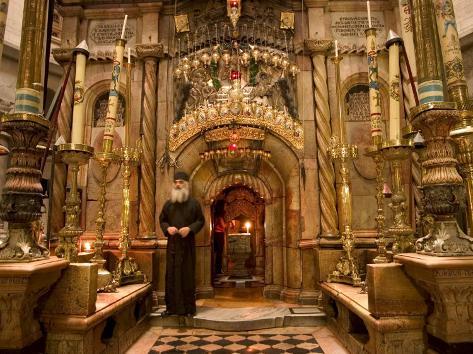
While Christians see Jerusalem as holy for their own purposes, their focal point in modern times lies in the physical places where Jesus was. The picture above is the tomb of Christ at the Holy Sepulcher Church. Eastern Orthodox Christians have their roots in Jerusalem. Other sects of Christianity go on pilgrimages to Jerusalem, parts of Israel, and parts of Palestine in order to see these holy sites that impacted their religion so greatly. Armstrong discusses how early Christians in Jerusalem often kissed and touched the ground where they believed Christ had once walked and experienced events noted in the Bible. As Armstrong notes, this excited physical love and worship unfortunately did not lead to a more peaceful group rooted in their beliefs. These ancient Christians began to see Jerusalem as the Jews did. The idea of sacred geography begins to apply to the Christians who were supposed to, according to the synoptic gospels, travel around the world to spread the good news. They found their roots in Jerusalem and did not want to leave either. While this is not the case in modern times, it has only added to a modern problem of Jews wanting to maintain a stronghold on their holy land, despite the fact that others want to peacefully live there as well. As we know, the Crusaders came into Jerusalem and committed horrid atrocities. This is a terrible part of history, but Christians are not really fighting for their right to be in Jerusalem now, as many peacefully go on pilgrimages today.


Islamic Holy City

As opposed to delving into the pre-Jerusalem portion of Islamic history, I am going to focus my response on Muslims once they entered Jerusalem. Having already taken several Islamic focused courses in college, I was really eager to see what Armstrong had written about Muslims in Jerusalem. I was glad to see her focus on the fact that it was not until the eighth century that there was any pressure to convert to Islam (despite the fact that Islam is still not supposed to be a universalizing religion). As the Islamic empire spread, there was only one Islamic holy site in all of Jerusalem, and Christians and Jews were treated with respect by their new governor. However, with Muslims being a majority, the Jews and Christians were not happy. The Jews were particularly unhappy about the fact that the Dome of the Rock, pictured above, was built where Isaac was almost sacrificed, but the descendants of Ishmael were in control. This place was considered a place where earth and heaven met and was incredibly holy. Jerusalem was becoming increasingly more focused on Islam, but the empire began to collapse. The Umayyad dynasty fell and the Abbasids rose to power, moving their capital to Baghdad. But Jerusalem would remain a holy city in the eyes of Muslims, especially when so many remained in Palestine. Their holy site at the Dome of the Rock is key, plus the three holiest cities to Muslims are Mecca, Medina, and Jerusalem. This is another claim to the city. Plus, with many Arabs moving into the area and settling in Palestine and staying for so long, they also have a claim to part of the region.  This further complicates the issue, as it is impossible to push out Jews and/or Muslims.

Both Jews and Muslims have legitimate claims to the territory based on religion. Beyond that, their political claims are legitimate as well. They all lived in the area for years. They built up homes and raised their families in Jerusalem. How does one decide who must leave? Should anyone leave? Should they coexist? Can they coexist? Can they let animosity go? Is this too idealistic of an idea? Is it a realistic goal at all? These are all questions that must be discussed, but only time will tell us the answers.

Discussion Questions

1. For those who are religious, do you find that your faith impacts how you feel about the issue of Jerusalem in who should live there and control it politically? 
2. If Jews began to find ways to worship without having the Temple after the destruction in 70 a.d., does it seem to be religiously imperative for them that they have total control over Jerusalem? 
3. Do you think religion should play a role in considering who should control Jerusalem? Or is it feasible that Jerusalem remain divided?