Wednesday, January 29, 2014

Week 4 Reading Response: A Holy City for All

Again, Karen Armstrong's book doesn't disappoint! There were several points that she mentioned that got me thinking about the conflict today, specifically the history of who sees Jerusalem as holy and as such for what religions.


Jewish Holy City (supported by more than just Jews)

In Chapter 8 (pg. 155 in my book), she says that "the Temple had represented the heart of the world's meaning, the core of the faith. Now life had neither value nor significance, and it seems that in these dark days many Jews lost their faith." She goes on to say Jerusalem and the Temple were central to their religion. The fixation on the Temple and the return to Jerusalem manifests itself today (and many Protestant Christians support this notion as well) in what we see as the fight over Jerusalem. However, from a Christian theological standpoint, the fundamentalist Christian support seen today seems to be based on flawed logic. Armstrong mentions the Hebrew word "Shekhinah," which is the presence of God, specifically in the holy of holies. Jews would worship at the Temple and the smoke that came out of the top showed the presence of the Shekhinah. The Shekhinah had to be blocked by a veil at all times, as any human who laid eyes on God would instantly die, and only the high priest could even enter the holy of holies. However, in Jeremiah, this notion goes away: 


For this is the covenant that I will make with the house of Israel after those days, declares the LordI will put my law within them, and I will write it on their hearts. And I will be their God, and they shall be my people. And no longer shall each one teach his neighbor and each his brother, saying, ‘Know the Lord,’ for they shall all know me, from the least of them to the greatest, declares the Lord. For I will forgive their iniquity, and I will remember their sin no more.” (Jeremiah 31:33-34, ESV)

The covenant has changed: people can directly access God through prayer and they are no longer required to go to the Temple to experience the Shekhinah. As Armstrong mentions, the Jews began to study Torah in order to experience the holy presence of God. However, in reading the Armstrong passage and reflecting on some of the actual words of the Bible, it makes sense that Jews want to return to Jerusalem and feel that it is necessary. However, it makes no sense to me that there seems to be such a Christian focus on the Jews returning to Jerusalem. There is of course the belief that in order for Christ to return, there must be the construction of a new temple; the words of Jeremiah suggest otherwise. The Temple suddenly becomes not a physical construction, but a concept. Yet still today we see a strong Christian push for Jews to return to Jerusalem and make it a strictly Jewish homeland and political state.

My reason for spending so much time on this is the fact that I have discussed with many Christians their strong support for not just the political state of Israel, but for Israel to encompass all of Jerusalem. This only adds fuel to the fire, as it adds a much more religious focus on the conflict rather than a political one (despite the fact that it has been obviously rooted in religion historically, but has expanded to a much more political issue).


Christian Holy City
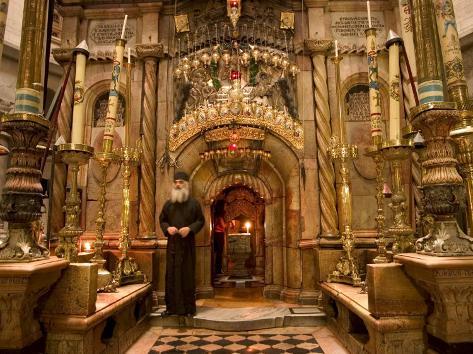
While Christians see Jerusalem as holy for their own purposes, their focal point in modern times lies in the physical places where Jesus was. The picture above is the tomb of Christ at the Holy Sepulcher Church. Eastern Orthodox Christians have their roots in Jerusalem. Other sects of Christianity go on pilgrimages to Jerusalem, parts of Israel, and parts of Palestine in order to see these holy sites that impacted their religion so greatly. Armstrong discusses how early Christians in Jerusalem often kissed and touched the ground where they believed Christ had once walked and experienced events noted in the Bible. As Armstrong notes, this excited physical love and worship unfortunately did not lead to a more peaceful group rooted in their beliefs. These ancient Christians began to see Jerusalem as the Jews did. The idea of sacred geography begins to apply to the Christians who were supposed to, according to the synoptic gospels, travel around the world to spread the good news. They found their roots in Jerusalem and did not want to leave either. While this is not the case in modern times, it has only added to a modern problem of Jews wanting to maintain a stronghold on their holy land, despite the fact that others want to peacefully live there as well. As we know, the Crusaders came into Jerusalem and committed horrid atrocities. This is a terrible part of history, but Christians are not really fighting for their right to be in Jerusalem now, as many peacefully go on pilgrimages today.


Islamic Holy City

As opposed to delving into the pre-Jerusalem portion of Islamic history, I am going to focus my response on Muslims once they entered Jerusalem. Having already taken several Islamic focused courses in college, I was really eager to see what Armstrong had written about Muslims in Jerusalem. I was glad to see her focus on the fact that it was not until the eighth century that there was any pressure to convert to Islam (despite the fact that Islam is still not supposed to be a universalizing religion). As the Islamic empire spread, there was only one Islamic holy site in all of Jerusalem, and Christians and Jews were treated with respect by their new governor. However, with Muslims being a majority, the Jews and Christians were not happy. The Jews were particularly unhappy about the fact that the Dome of the Rock, pictured above, was built where Isaac was almost sacrificed, but the descendants of Ishmael were in control. This place was considered a place where earth and heaven met and was incredibly holy. Jerusalem was becoming increasingly more focused on Islam, but the empire began to collapse. The Umayyad dynasty fell and the Abbasids rose to power, moving their capital to Baghdad. But Jerusalem would remain a holy city in the eyes of Muslims, especially when so many remained in Palestine. Their holy site at the Dome of the Rock is key, plus the three holiest cities to Muslims are Mecca, Medina, and Jerusalem. This is another claim to the city. Plus, with many Arabs moving into the area and settling in Palestine and staying for so long, they also have a claim to part of the region.  This further complicates the issue, as it is impossible to push out Jews and/or Muslims.

Both Jews and Muslims have legitimate claims to the territory based on religion. Beyond that, their political claims are legitimate as well. They all lived in the area for years. They built up homes and raised their families in Jerusalem. How does one decide who must leave? Should anyone leave? Should they coexist? Can they coexist? Can they let animosity go? Is this too idealistic of an idea? Is it a realistic goal at all? These are all questions that must be discussed, but only time will tell us the answers.

Discussion Questions

1. For those who are religious, do you find that your faith impacts how you feel about the issue of Jerusalem in who should live there and control it politically? 
2. If Jews began to find ways to worship without having the Temple after the destruction in 70 a.d., does it seem to be religiously imperative for them that they have total control over Jerusalem? 
3. Do you think religion should play a role in considering who should control Jerusalem? Or is it feasible that Jerusalem remain divided?

Monday, January 27, 2014

Journal 2

It's very easy as an outsider to look at the conflict of other's and draw up a solution. Without the same type of attachment or firsthand experience with the conflict, assumptions are easily made. However, drawing upon specific facts is crucial to having a fair resolution to Palestinian-Israeli peace talks.


BORDER CHANGES

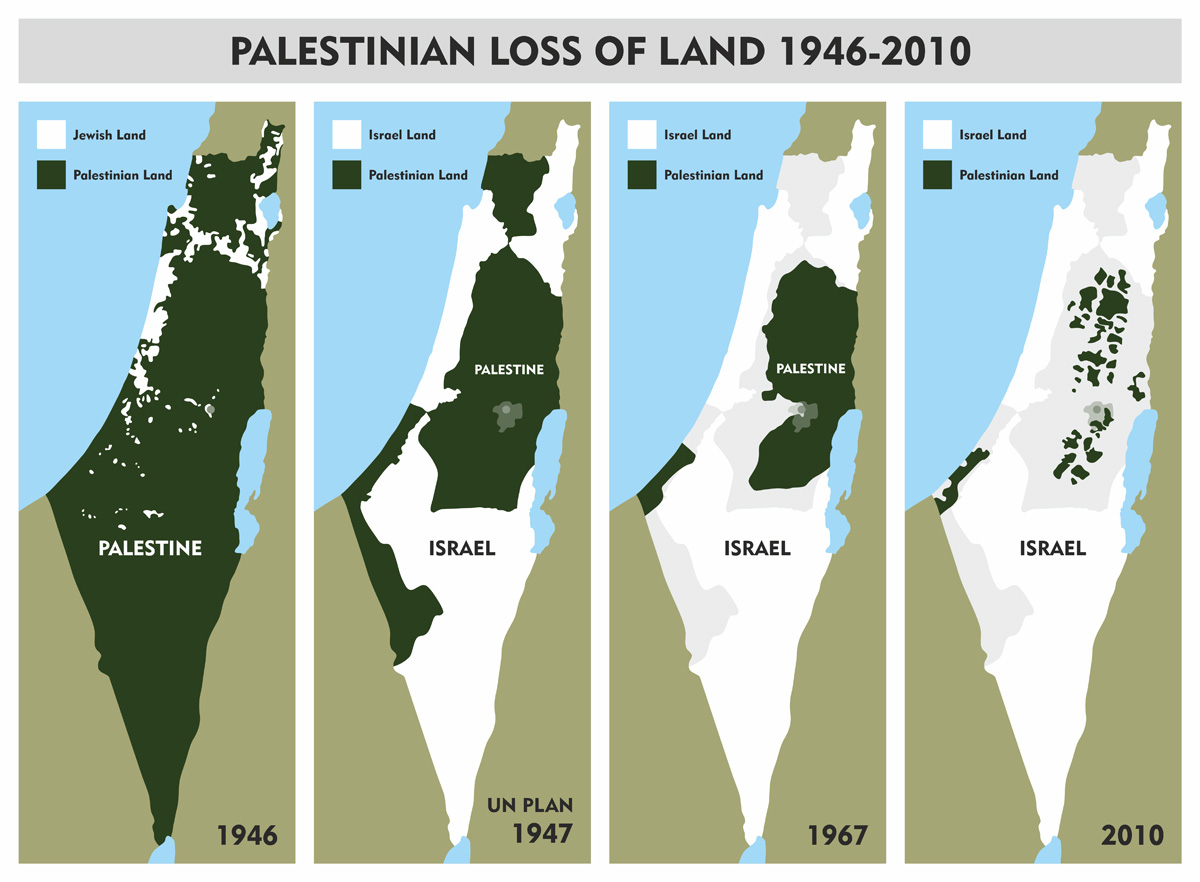
This is a map of the land that Palestine has lost and Israel has gained. Many of you may have already seen this map, but it paints a very real picture of how land has changed hands since the establishment of Israel in 1948. I am not suggesting that a solution would be to go back to the original borders, but it's important to remember what Palestinians have had to give up and what Israel has gained both legally and illegally, and that they believe their land gain is legitimate. Whether or not it is is up for debate. In negotiations between Israeli and Palestinian leaders, there has been much talk about returning to the 1967 borders (or "The Green Line"). Israel will not agree to that. However, Israel should take this consideration very seriously, even if they do not want to completely return to those borders. It would legitimize and recognize the struggle that Palestinians have endured in losing land and get peace talks back on track. While this seems like a huge negative for Israelis, there has to be some sort of compromise and this would be a good starting point.


HALT SETTLEMENT CONSTRUCTION

This is a point that has been made over and over again by Palestinians in negotiations, but if Israel hopes to get peace talks back on track, they must stop constructing settlements (especially since many are only for Jewish settlers). It's difficult to discuss this without going into great detail, but there are several key points to make here. First, the creation of Israeli settlements on Palestinian territory is illegal under international law. This is the consensus of the majority of the world, including most European nations. The US does not agree with this and has supported Israel unconditionally. Secondly, Israel needs to recognize some element of Palestinian sovereignty in order to legitimize talks. Constructing settlements on their territory has the opposite effect. This issue has greatly impacted peace talks and Palestine has refused to return to the table on several occasions if Israel does not stop the construction of more settlements. However, it was revealed in 2012 that Israel had plans to construct more settlements. This pattern must stop, as continuously violating the rights of those with whom you are attempting to have peace talks completely illegitimates that group. This must end for proper and legitimate negotiations to take place.


CALL TO STOP VIOLENCE--AND ENFORCE IT

Both Israelis (specifically the Israeli Defense Force) and Palestinians are guilty of committing unspeakable atrocities to each other. It should be noted that Palestine does not have an official military, and Israel boasts the 6th most powerful military in the world (which is partly funded by the country with the strongest military in the world--the US). Both sides have called for an end to violence, but it has not at all been enforced. While Palestinian violence is not comparable to the scale of which Israelis have committed violence, which is a simple fact, it is violence nonetheless (and the picture I chose is biased, I know, but illustrates a true fact). Israel funds the violence of the IDF and the Palestinian Authority does not call for an end to violence, and Hamas often encourages violence as the governing party of the Gaza Strip. While both sides can attempt to justify the use of violence in the name of self-defense, it is impossible to have peace talks when there is constant back and forth violence between the two nations. This should be done by state-sponsored education. There seems to be acceptance of violence in the two countries, whether outwardly or not. If the nations truly condemned violence as needed, there would not be the violence that there is today. It has to stop to make peace talks possible. Those who commit violence are only making the situation more difficult and both sides less trusting.

PALESTINIAN STATEHOOD

While this has been a contested issue and there are many, many pros and cons to official recognition of a Palestinian state, there needs to be at least some type of Israeli recognition of Palestinian sovereignty to legitimize peace talks, which I touched on earlier. Israel enjoys many benefits of being an internationally recognized state, yet Palestine has to fight to be recognized (and many countries have done so). This makes the Israeli position seem legitimate, and Palestine's position look as if it's a rogue group of people committing violence against another country. While this is obviously not the case, that is how it appears to many. This is not fair in a conversation between "equals." There is no equality if Palestine cannot even be considered sovereign, if not a state. This would require a real unification of the government leaders in the West Bank and Gaza Strip. But it's a necessary unification and necessary step for the peace process.


Ultimately, there are many difficult compromises that must be made in order for peace talks to happen, and I've only been able to touch on a few. But it's key for both sides to remember that humans are humans. This is often something that governments and angry groups of people can forget. But they are key for achieving peace. Both sides must keep their eye on the goal and build bridges of understanding. This is very idealistic, but it's what's necessary. In order for any movement to stick, it must be grassroots and it must be fair, or there will always be revolt. This has been shown time and time again throughout history when governments have tried to use people as pawns for a political end. Israelis and Palestinians want peace, as they want to live functional lives. Their goals and desires are not much different from each other. They want to survive, be successful, and be happy, which is the goal of most human beings. They must all work together for a common goal. This requires putting at least violence aside. They don't have to be happy with how history has played out, but they must accept each other's existence in order to live next to each other, which is going to be the only solution.

Thursday, January 23, 2014

Week 3 Discussion Post

Today's discussion of the Karen Armstrong reading really provoked me to think about the perception of history depending on who's reading it. We usually think of history as something that's proven based on documents and evidence. The ancient history of Jerusalem is not nearly as objective as other parts of history. It isn't like studying World War II or the formation of the state of Ohio. Jerusalem is such a vastly different type of discussion, which is key in understanding the roots of conflict over the city. We must remember that we don't have all the facts and more than likely never will. However, this does not stop people from having opinions about the history--perceived "truths" that lead them to believe what they believe should be the fate of the city, who should occupy it, etc.

Hearing other people's perspectives based on their backgrounds was interesting to me. I have always had a specific perception about the history of Jerusalem based on what my religion taught me, as well as what I had learned in school. Others also had backgrounds in learning the history of Jerusalem, yet we all believed pretty much the same things about the history. I think that makes for a fantastic starting point for the rest of our discussions.

I was also very impressed by how much everyone had clearly thought about the reading. Everyone had something to say, which is usually not the case in most classes (making for an awkward class period). I look forward to discussing the rest of Armstrong's chapters next week with you all.

Wednesday, January 22, 2014

Karen Armstrong Reading Response - Week 3


The first reading was lengthy, but I loved it! I have read other Karen Armstrong books and she is an excellent author. (If you haven't read more from her, you definitely should!) Having attended a Catholic school for most of my years before college, I had much of Jerusalem's history drilled into my head. I also had to study Kings 1 and Kings 2, which are the biblical accounts of early Judea. But it never fails to interest me. As opposed to focusing on each of the 7 chapters that we all read (which is some dense material!), I'm going to just focus on some of the aspects that I found particularly important to my understanding of Jerusalem's history.

1. Lack of solid evidence: Armstrong starts out by acknowledging that "we know nothing" about the people who first settled the area that would become Jerusalem. There is an immediate acknowledgement of the lack of solid evidence about who was in Jerusalem first, or what the exact history of Jerusalem is. I noticed that Armstrong used the Bible as a reference, which is not really looked at as a credible historical source, which Armstrong knows. It just goes to show that we cannot definitively know what she is saying is true. Her honesty makes it easier to approach this book that is probably controversial to many.

2. Basic acknowledgement of Abrahamic religions: people LOVE to separate Christianity, Judaism, and Islam. Many do so for divisive purposes. Yet the roots of these three major world religions are the same. Everyone traces their roots back to Abraham. She explains the split between the descendants of Ishmael and Isaac, but does so to explain to historical separation of the religions as well. She doesn't try to make it seem as though this is some sort of dogmatic difference. While this seems elementary, I was glad to see it in a book that I hope others pick up who don't understand that these three religions share the same roots.

3. Spirituality in geography: I was completely fascinated by the idea that people chose to build temples in places where they felt some sort of connection with their respective gods. It makes the obsession with Jerusalem seem somewhat arbitrary and less meaningful. For those who think that a specific ethnicity belongs in a certain place due to any religious reason should examine this idea. There are many places in that area that people felt moved by their gods. It was not about a specific area being holy. No place was holier than another. Many places were holy and God could be found almost anywhere. In the beginning of people inhabiting the area surrounding modern Jerusalem, no one even seemed to care about Jerusalem. It seems that people have lost the point of "holy land." While the Israeli-Palestinian conflict is not religious in nature, many conservative Christians in the United States lobby to fund specifically Jewish inhabitation of modern Israel due to their biblical interpretations. In the face of that logic, this idea could easily nullify that rationale.

4. Coexistence: Armstrong explores King David's takeover of Jerusalem where the Jebusites had lived. Unlike many takeovers, he did not harm the Jebusites. He took over political control, but allowed the former king to retain his estate and he kept Jebusite officials to help him run the city. While things did not remain so peaceful forever in ancient Israel, it showed the capability of coexistence. This idea has been completely lost in modern times, including in this area. I thought her inclusion of that was an interesting thought to ponder in light of current events.

5. Mythology and symbols: one of the most frequently run-into issues I have had with religious conversations, especially with where I grew up, were questions about what I think is religious "mythology." The best example is the story of creation, which I believe in a symbolic story to explain that God created the world. The story of Adam and Eve is simply to explain that humans are fallen in nature and imperfect creatures, which sets up the future New Testament covenant of Jesus redeeming humanity through his death as both a fully human and fully divine being. Being raised in a Catholic tradition, I was never raised to take these stories literally. As I got a little older and found out that people took them literally, I was surprised. Armstrong mentioning symbols and myths about religion was great, as it reminds us that much of what is believed about Jerusalem is symbolic and/or mythical. That doesn't make them any less important, as these myths and symbols still greatly impact how people feel, think, and react to the question of Jerusalem that is faced today.

Discussion questions:
1. What do you think about the historical precedent of coexistence in Jerusalem? Do you think that there is a lesson to be learned from the story of David, or is it too far removed at this point to be relevant?
2. Is the spirituality in geography idea relevant to the current issue, or is it now too politically and culturally involved to matter? Do you think if somehow the spirituality in geography idea were totally removed from the conflict that it would make a difference in how people feel about it, at least in the United States amongst fundamentalist Christian groups?

Journal 1

Well, I've only experienced one class session at this point. However, I already do have some things I'm reflecting upon in regards to the class and this semester. I'm really looking forward to the progression of this class, as I was able to learn on Tuesday more of what we would be doing in this class.

I'd like to start by saying I really like the structure of the class. The somewhat informal and experimental setting is interesting, especially having been at OSU with its giant classes and mostly formal lecture settings. I am excited about the video conferences we're going to have. It is one thing to study the Israeli-Palestinian conflict from an intellectual standpoint, reading textbooks on the issue. When Edward Said used the term "orientalism," he was referring to those in the West studying the Middle East and misunderstanding it as an underdeveloped region. This patronizing attitude has always been frustrating for me to see in my international studies classes. While I have never visited the Middle East myself, I want to study the region by actually interacting with those who have lived there. I am thrilled that this course is going to offer that opportunity to me. I know people who have lived in Israel, Palestine, Lebanon, Egypt, and other countries in the Middle East, and their stories have all moved me in different ways. They have allowed me to vicariously experience another culture in another part of the world. Being able to experience more of this through video conferences will no doubt be an interesting and enlightening experience.

I have been reflecting upon how I became so attached to the Israeli-Palestinian conflict in the first place. I grew up in a small town about an hour away from Columbus. It is an extremely conservative, all white town. I was even looked down upon by some for being of Italian descent (and even more so for being Catholic). It is such a closed off town and there is little opportunity to experience anything outside of that town. In high school, I joined a national debate organization that allowed me to go to conventions in Washington, DC, and Columbus. It was there that I met my first boyfriend, Abdul, who was from Lebanon. His family was of Lebanese and Palestinian descent. I knew nothing of the Israeli-Palestinian conflict except that it existed, due to Fox News coverage I would see at home and from my grade school religion classes. I learned quite a bit from Abdul and his family. Hearing the stories about his family being torn apart and his grandfather being abducted and killed by the IDF moved me more than anything I had ever heard in my life, perhaps because I knew someone I cared for had something traumatizing happen to them. I knew from our hours and hours of discussion on the topic that I had to know more about it to try to wrap my mind around what had happened. One of the books that motivated me academically was "The Israeli Lobby and US Foreign Policy." I became more intellectually invested in the conflict and realized that I wanted to dedicate my life to bringing about justice for those impacted by this conflict.

I know I definitely have very strong preconceived notions about the conflict, but I'd also like to think of myself as having a fairly educated opinion. I would imagine that many of my fellow students have very strong feelings about the topic and educated opinions. I am excited to hear them all, whether or not they agree with me. I want to discuss the issue with those who do not agree with me in an academic setting, as those that take place outside of academia tend to become very heated (as with many political topics in general). I hope we can all use these blogs to talk more about the conflict not just in a modern context, but also in a historical one. A respectful, constructive dialogue is exactly what I hope to glean from this class. We are clearly all opinionated, passionate people. And that is such a wonderful thing that I look forward to experiencing more as this class moves forward.

Monday, January 20, 2014

A Brief Introduction

Hi classmates,

My name is Rachel and I'm a senior this year. I anticipate graduating this summer with a B.A. in International Studies and a B.A. in Political Science. I am also minoring in Italian. I began my studies at OSU as focusing my international studies degree on the Middle East; however, I wanted to take both Arabic and Italian, but already had a background in the Italian language. I decided to focus on international relations and diplomacy as opposed to the Middle East for more flexibility in language choices for my course of study. I plan to go to law school soon after graduation and want to study Arabic after I graduate at whatever institution I end up.

I have had a very strong attachment to the Israeli-Palestinian conflict since high school and focused much of my free time studying the conflict, which led to my eventual choice to major in international studies. I became My dream job would be working as a human rights attorney in Palestine, but we'll see where life takes me after law school. I am really excited to join this class and delve more deeply into a topic that has always fascinated me due to its political, legal, ethnic, and religious overtones--four topics that I also love to discuss.

I also am a volunteer English teacher at a refugee resettlement center in Columbus and work with mostly elderly refugees from Bhutan. It's so interesting as an American (who automatically has privilege, comparatively speaking) to hear the plights of others that I cannot possibly grasp. It drives me to want to help them as much as humanly possible. Going to their homes and seeing how little they have and the horrors they have experienced in their lives, yet seeing their grateful attitudes and warm personalities, reminds me of my passion to help those who are at a disadvantage in a variety of ways: mental health-wise, socio-economically, and so on.

So in sum, my main interests lie in human rights and refugee-related issues, which is seen clearly in the Israeli-Palestinian conflict. I look forward to discussing the nuances of such a complex issue. I also look forward to hopefully discussing solutions to the issue surrounding not just the Jerusalem question, but the conflict as a whole.

I look forward to discussions with you all!

Rachel